In the fields of biological sciences, novel drug R&D, and the development of innovative cosmetic ingredients, standardized peptides often fall short of meeting diversified scientific and market demands, making "custom peptides" essential. Custom peptides require tailored manufacturing based on the specific amino acid sequences, purity levels, and modification methods requested by clients. How does a professional peptide facility transform these personalized molecular blueprints into high-quality physical products? It relies on highly digitized management and precision engineering workflows.
1. Demands Evaluation and Process Route Design
The production of a custom peptide begins with an in-depth evaluation of its technical feasibility. Upon receiving a client's sequence, the technical team at a professional facility utilizes computational biology software to analyze its physical and chemical properties (such as hydrophobicity, stability, and synthesis difficulty). Based on these insights, engineers tailor the optimal synthesis route. Whether selecting Solid-Phase Peptide Synthesis (SPPS), liquid-phase synthesis, or specialized fragment condensation techniques—and deciding at which exact step to introduce specific chemical modifications (such as phosphorylation, methylation, cyclization, or fluorescent labeling)—a rigorous process plan must be established before production commences.
2. Automated High-Throughput Synthesis and Real-Time Monitoring
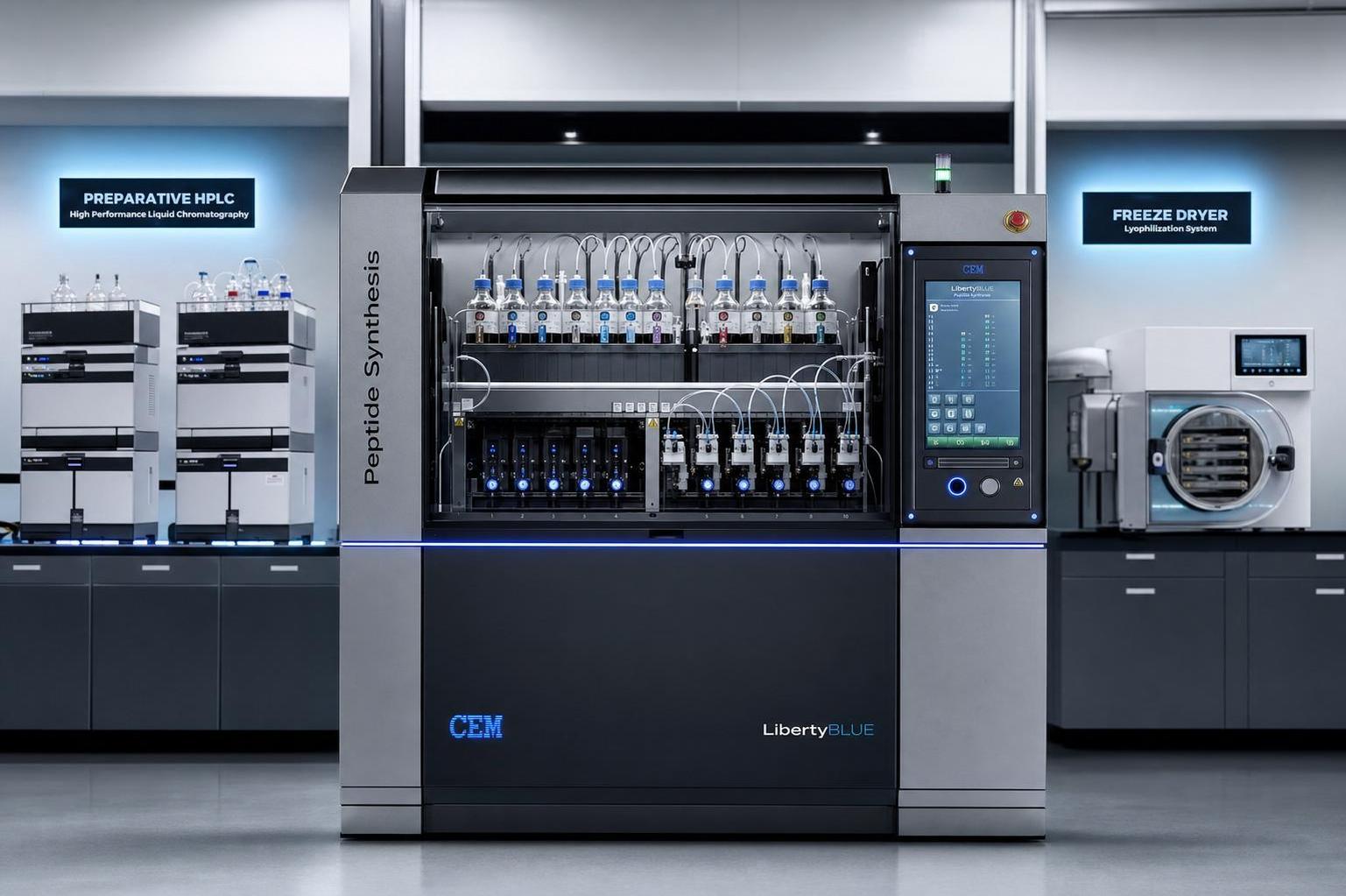
Once in the production stage, professional peptide facilities typically employ advanced, automated peptide synthesizers.
◾ Precision Reagent Fluid Control: Under programmed control, the equipment precisely introduces activated amino acids into the reaction system according to the designated sequence. Automated rapid washing and coupling processes significantly reduce the risk of cross-contamination and incomplete coupling associated with manual operations.
◾ In-Process Control (IPC): At critical nodes of synthesis, techniques such as the ninhydrin test are used to monitor the coupling rate in real time, ensuring that the attachment efficiency of each amino acid meets high standards, which lays a solid foundation for achieving high purity downstream.
3. Fine Purification and Targeted Lyophilization
Following synthesis and cleavage from the resin, a crude mixture of the custom peptide is obtained. To transform this into a finished custom product that meets client specifications, precise post-processing must be performed.
◾ Targeted Purification Schemes: Since each custom peptide possesses completely distinct charge and hydrophobicity profiles, the purification team formulates specific mobile phase systems based on molecular characteristics, utilizing preparative High-Performance Liquid Chromatography (Prep-HPLC) for step-by-step collection and precision purification.
◾ Customized Lyophilization: The purified peptide solution undergoes vacuum freeze-drying (lyophilization) to remove moisture, converting it into a loose, easily storable, and highly soluble powder, thereby ensuring the long-term stability of the molecular activity.
At the conclusion of the entire workflow, the quality control department conducts a final inspection of the finished product using Mass Spectrometry (MS) and analytical HPLC to issue a comprehensive Certificate of Analysis (COA) detailing purity and molecular weight, ensuring the custom peptide fully aligns with the client's expected standards.
Related Posts
- ▶ How Do Global Buyers Verify the Production Capacity of a Peptide Facility?
- ▶ Why Do Researchers Prefer Cooperating Directly with Peptide Facilities?
- ▶ What Certifications Should a Peptide Manufacturer Possess?
- ▶ How Does a Reliable Peptide Facility Ensure Product Consistency?
- ▶ How Does a Professional Peptide Facility Manufacture Custom Peptides?
- ▶ Why Quality Control is Essential in a Peptide Manufacturing Facility ?